More specifically, the amendments to the Employment Contracts Act provide that:
The employer is required to provide the job applicant with information on the pay or pay range in a format that can be reproduced in writing no later than before the job interview.
The information must be provided sufficiently in advance of the job interview so that the candidate has time to prepare for salary negotiations.
Information on the pay or pay range must be provided in a format that can be reproduced in writing. This may include, for example, publishing the pay in the job advertisement or sending the information to the job applicant by email or SMS.
If the employer does not disclose pay information in the job advertisement, it must be provided to candidates who are invited to a job interview.
The pay range must be realistic and based on the basic pay for the position offered. Information on additional remuneration may be provided but is not required.
If additional pay conditions arising from a collective agreement apply to the specific position, such as bonuses or supplements, information must also be provided about these.
Even today, it is prohibited to ask disproportionately private questions during a job interview. The amendments explicitly clarify that questions about the candidate’s previous or current pay are prohibited.
Even today, employers are prohibited from including contractual terms that restrict employees from talking about their own pay. The amendments state specifically in the Employment Contracts Act that an employer must not prevent an employee from disclosing their own pay.
This means that both contractual terms prohibiting the disclosure of pay and other restrictions are prohibited.
In addition, the amendments introduce into the Employment Contracts Act an obligation for employers to ensure equal pay for equal work or work of equal value between women and men. The same principle has applied under the Gender Equality Act since 2004.
The employer is free to choose how to ensure equal pay for equal work or work of equal value between women and men.
The principle of equal pay for equal work or work of equal value between women and men means that the employer must pay equal remuneration for the same work or work of equal value, unless there are objective and gender-neutral reasons for different pay.
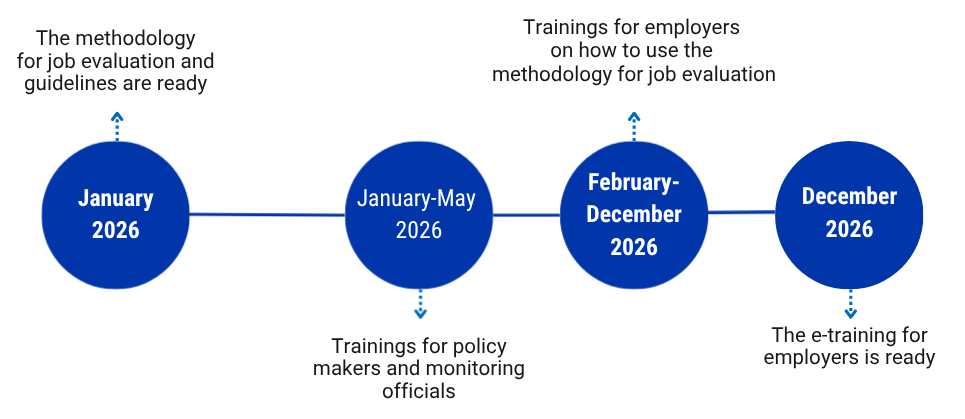
Employers have access to a voluntary methodology and tool for assessing the value of jobs. Employers will also be offered free training in 2026 on job evaluation and the creation of pay structures. More information is available under project PALK.
More information about the Pay Transparency Directive
The Council of the European Union adopted the Pay Transparency Directive on 24 April 2023. The aim of the Directive is to achieve a situation where women and men are paid equally for work of equal value. Member States were required to transpose the Directive by 7 June 2026. The transposition of the remaining requirements is not currently under legislative procedure.
The main requirements of the Directive that are not currently being transposed are:
Pay formation must be based on a pay structure.
The criteria used to determine pay must be accessible to employees.
Upon request by an employee, the employer is required to provide the employee with information on the average pay of women and men performing work of equal value to the employee’s work.
Large employers must submit a gender pay gap report.
Employers with 100–249 employees should submit the report every three years.
Employers with 250 or more employees should submit the report every year.
If the employer uses Statistics Estonia’s data transmission service, Statistics Estonia could prepare the report. In that case, the employer would only have to provide Statistics Estonia with additional information on employees performing work of equal value.
If the report reveals gender pay gaps among employees performing work of equal value, the employer cannot explain them on the basis of objective and gender-neutral criteria, and the employer does not remedy the situation within six months, the employer must carry out a joint pay assessment, or pay audit.
No employee’s individual pay will become public unless the employee discloses it themselves.
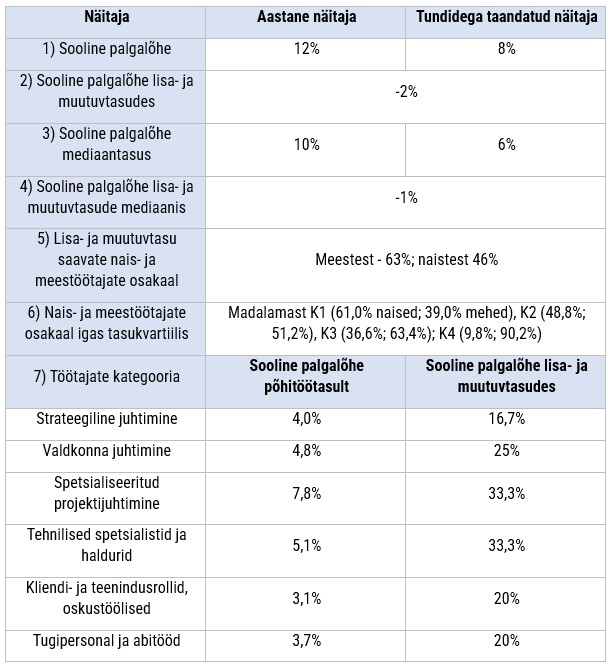
Example of a gender pay gap report: Employer X: (the employer chooses the names of the employee categories and groups employees on the basis of the equivalence of jobs)
Although the obligation to submit gender pay gap reports will not enter into force at this stage, employers can use Pay Mirror, which makes it possible to monitor the gender pay gap situation in their organisation on a quarterly basis.
Pay Mirror is a solution supporting employers, enabling them to monitor the gender pay gap situation in their organisation on a quarterly basis.
Pay Mirror cannot be used to submit the gender pay gap report because the indicators in the application are not the same as those required by the Directive for the gender pay gap report. This is because the register data on which Pay Mirror is based does not include working hours or types of remuneration. Pay Mirror can be used by all employers regardless of the number of employees. Read more
For questions related to the Directive, please contact:
Helen Talalaev
Head of Gender Equality Policy
[email protected]
Project "PALK"
The state supports employers in ensuring wage transparency in order to achieve a situation where women and men are paid equal pay for equal work and to significantly reduce the gender pay gap in Estonia. The government is going to provide employers with a methodology for job evaluation and trainings for adopting the methodology. In this way, employers can prepare to meet the requirements of the Pay Transparency Directive, which will enter into force in Estonia on 7 June 2026.
The aim of the directive is to guarantee equal pay for equal work or work of equal value to men and women. In order to do this, employers will have to carefully plan their pay structures, evaluate jobs in their organization and provide employees with objective and gender-neutral criteria that are used to determine employees’ pay, pay levels and pay progression.
Many employers have already created a pay structure based on fair and transparent criteria. If this has not been done yet, employers will have to do it under the new requirements. However, employers are not left alone with these tasks - the government will help them with job evaluation to make it an effective tool for guaranteeing pay transparency. Among the methodology for job evaluation there will also be guidance material, trainings and e-training for the implementation of the methodology.
These activities are implemented with the "PALK" project, which includes:
- a comparative analysis of job evaluation methodologies
- on the basis of the analysis, selecting and adapting an appropriate methodology for Estonian employers, including the preparation of guidelines
- carrying out trainings for employers on job evaluation and reducing the gender pay gap and developing e-training
- building institutional capacity among policy makers and monitoring officials of gender pay gap (including trainings, guidelines, study tour to acquire good practices)
As a result of the project:
- employers are more familiar with the requirements of the Pay Transparency Directive
- the authorities that advise and monitor employers are capable partners for employers on the topic of pay transparency
- a methodology for job evaluation suitable for Estonian employers will be made available free of charge
- pay structures are more transparent and the gender pay gap is reduced within organizations
- employers are meaningfully involved in gender equality initiatives and want to reduce pay inequality
- pay transparency will become the norm among employers, thus the gender pay gap will decrease in Estonia and the job market will become more equal
The project is implemented by the Ministry of Economic Affairs and Communications, the Labor Inspectorate and the Office of the Gender Equality and Equal Treatment Commissioner.
The project runs from January 1, 2025 to December 31, 2026.
The guidelines and other materials produced during the project are published on this page, on the Tööelu portal and on the websites of project partners. The e-training is published in the Digital State Academy.
The project budget is 372,895 euros, of which 335,605 euros is financed by the European Union through the Citizens, Equality, Rights and Values Programme CERV (CERV-2024-GE).
For questions related to the project, please contact:
Helen Talalaev
Gender equality project manager, Ministry of Economic Affairs and Communications
[email protected]